April 14-Monday of Holy Week

Here is my servant whom I uphold,
my chosen one with whom I am pleased,
Upon whom I have put my Spirit;
he shall bring forth justice to the nations,
Not crying out, not shouting,
not making his voice heard in the street.
A bruised reed he shall not break,
and a smoldering wick he shall not quench,
Until he establishes justice on the earth;
the coastlands will wait for his teaching.

Isaiah 42: 1-4

Here are the complete readings for Monday, April 14, 2025.

(“Mary of Bethany” by Joy George William)

I’m guessing I would have sneered at Mary of Bethany just like Jesus’ friends did. What was her motive, and why put on such a show that was so wasteful, especially when Jesus was always talking about taking care of poor people! That is the problem with judgments like this. We don’t often understand peoples’ intentions, much less what comes from their hearts. Clearly, Mary’s heart was very full as she reached out to Jesus that day. Her concern was not to show off wealth or piety. It was about a relationship and connection with someone who loved her, perfume or no perfume. When we are feeling judgmental, perhaps we should flip the script, and question our own motives for feeling this way. What within our hearts is causing this indignation? What about us is unhappy that then draws us into behavior that severs relationships rather than weaving them together? Consider the unlikely “servant” in the words of the prophet Isaiah. This person is not whom he seems. He is gentle and compassionate, yet more powerful than the mightiest warrior. It is this compassion that can bring former foes together to defeat the common enemy of injustice. Like Mary and the servant, may we lead with our hearts to be open to who our loved one, neighbor or adversary could actually be, not as we would have them be.

Listen to your brothers and sisters,
be compassionate with them in their difficulties,
bear with them in their weaknesses,
encourage and support them.
Affirm your brothers and sisters in their gifts,
for by doing so you enable them to realize the gifts that God has given them
for service. 
– The Fundamental Principles of the Xaverian Brothers

God, Your path is not always the path we would have chosen. Thank you for never forcing us onto a path, but giving us signs that we can choose to follow as we are able. You call us to repent and be transformed, but you accept us just as we are. Help us be patient and loving to our companions as you are to us.

Amen

April 13-Palm Sunday of the Lord’s Passion

My God, my God, why have you abandoned me?
All who see me scoff at me;
they mock me with parted lips, they wag their heads:
“He relied on the LORD; let him deliver him,
let him rescue him, if he loves him.”
My God, my God, why have you abandoned me?
Indeed, many dogs surround me,
a pack of evildoers closes in upon me;
They have pierced my hands and my feet;
I can count all my bones.
My God, my God, why have you abandoned me?
They divide my garments among them,
and for my vesture they cast lots.
But you, O LORD, be not far from me;
O my help, hasten to aid me.
My God, my God, why have you abandoned me?
I will proclaim your name to my brethren;
in the midst of the assembly I will praise you:
“You who fear the LORD, praise him;
all you descendants of Jacob, give glory to him;
 revere him, all you descendants of Israel!”
My God, my God, why have you abandoned me?

Psalm 22:8-9, 17-18, 19-20, 23-24.

Here are the complete readings for Sunday, April 13, 2025.

(“Entry of the Lord into Jerusalem” by Alexey Smirnov)

Contemplate the entire collection of readings for this Palm Sunday day as we enter into Holy Week. I chose to highlight Psalm 22 today because of the connection to Jesus’ last words prior to his death. Also, I have always appreciated the arc of this psalm. The narrator goes from despair to confidence over the course of each of the stanzas. Note that at the end, the person is not relieved of suffering and stress, but is emboldened by the presence of God they’d questioned at first. This psalm is about hope. That is the basis of all belief. It is not always rational, but life is not rational either. Hope can appear in the smallest and most barren of spaces, but hope has a special power. It grows, gradually but then exponentially, whatever the circumstances. Our life’s arc is limited to space and time, but hope is forever, like our God.

 Gradually,
you will realize
that the cost of your discipleship
is your very life,
freely consecrated to God
and offered to the world
as a sign of God’s love and care.
The gift you have received
give as a gift.
You have promised
to follow Christ, the poor man,
totally given in love to God
and for all people everywhere,
and whose loving obedience led Him
to death on the cross.
– The Fundamental Principles of the Xaverian Brothers

God, we thank you for the people in our lives who have been Christ for us. They respond to our suffering with compassion and walk the journey with us. They give of themselves with humble joy. The simplest encounters with them are rich with meaning. Their passion exudes a zeal that can sustain us in the darkest of trials. We trust in you, O Lord, that your presence and love transcends even death.

Amen

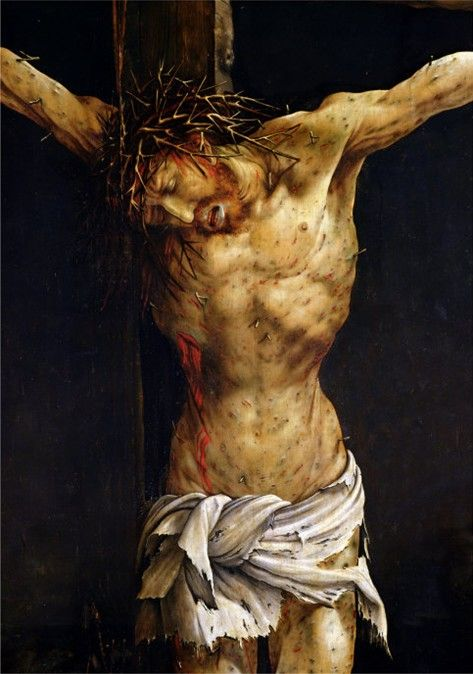
(“The Isenheim Crucifixion” by Matthias Grunewald)

April 12-Saturday of the Fifth Week of Lent

Thus says the Lord GOD:
I will take the children of Israel from among the nations
to which they have come,
and gather them from all sides to bring them back to their land.
I will make them one nation upon the land,
in the mountains of Israel,
and there shall be one prince for them all.
Never again shall they be two nations,
and never again shall they be divided into two kingdoms. I will make with them a covenant of peace;
it shall be an everlasting covenant with them,
and I will multiply them, and put my sanctuary among them forever.
My dwelling shall be with them;
I will be their God, and they shall be my people.

Ezekiel 37: 21-22, 26-27

Here are the complete readings for Saturday, April 12, 2025.

(“The Expectation of Lazarus” by Mamuka Georgadze)

“If you love somebody, set them free.” This is an incredibly difficult ask for a parent, or anyone who nurtures a protege who is ready to face life on their own. One of the lessons in today’s Gospel seems to be the need to recognize the need to say goodbye to those we love or that which we love in order to be able to experience joy. We cannot have one without first surrendering the other. Can this be sad? Of course! Hopefully we admit that letting go is hard and acknowledge when we feel grief. So much about being happy in the present involves the loss of something we clung to for comfort or support. Yet look at how optimistic the passage from Ezekiel presents the future. His words overflow with gratitude about the connections formed in the community, in all its diversity. This vision of the kingdom is possible only when the people are open to change and be transformed before they enter this new reality. This allows us to cherish and celebrate those we love and experience that love here and now.

 You are called
to be of one heart and one mind with them
so that you can participate
in the building up of the reign of God.
This was the vision
Theodore James Ryken had in view
when he founded the congregation:
A band of Brothers
who mutually help,
encourage,
and edify one another,
and who work together.
You are called then by your Founder
to enter into a true mutual sharing
with your brothers and sisters.
This sharing will demand of you
an opening and a giving of yourself to them
at many levels,
and a ready acceptance of each of them
in all their sinful and graced humanity.
– The Fundamental Principles of the Xaverian Brothers

God, you offer us freedom each day we awake. Thank you for the chance to share this day with you and your creation. When we are lonely and sad, comfort us with the hope and trust that you are present and listening. You remain always at our side.

Amen

April 11-Friday of the Fifth Week of Lent

He went back across the Jordan
to the place where John first baptized, and there he remained.
Many came to him and said,
“John performed no sign,
but everything John said about this man was true.”
And many there began to believe in him.

John 10: 40-42

Here are the complete readings for Friday, April 11, 2025.

(“John the Baptist Preaching” by Kehinde Wiley)

What do you typically find offensive? What triggers your visceral sense of outrage? Is it something you find crude or vulgar, or is it caused by what you perceive as an attack on your values? Jesus’ enemies felt the latter. They agreed that he was insulting their beliefs and culture through his words and actions. They called it blasphemy, or deliberately holding in contempt that which is sacred. Upon contemporary examination, these adversaries seem short sighted, insecure, and petty. However, can we put ourselves in the place of these men (they were all men in this case) to better understand their anger and perhaps shine some clarity on our own tendency to judge after feeling offended? Are we aware of any uncomfortable truths about us that may be raised by this offensive person or persons? Do we need to listen and discern before we reply? It is important to note that when Jesus was verbally attacked in public, he always replied with an invitation to the attacker to reflect on what they had just said, and to consider the source of what made them gnash their teeth. None of us are perfect, and there will be times when we are rightly angered by another person’s actions, especially if it mocks or marginalizes innocent people. Can we, through prayer and contemplation, differentiate between righteous anger and that which is caused by our own insecurity or fear of something simply because they are different than what we are used to? Perhaps we can appreciate what we once could not, as did the people in the Gospel about the words of John the Baptist.

 As you prayerfully reflect on the past,
assess the present,
and ponder the future with one another,
be considerate of this history
and of this ministry.
Yet, like Ryken,
foster an attitude of openness
to the needs of the Church and your world,
and a willingness to follow Christ
wherever He leads.
– The Fundamental Principles of the Xaverian Brothers

God, we are grateful for the little transformations in us that you make possible. The wisdom to know when we were wrong, and the courage to speak up for the outcasts we had once ignored. Thank you for giving us hearts that deep down are drawn towards you. May we listen and follow what our hearts call us to be.

Amen

April 10-Thursday of the Fifth Week of Lent

I will maintain my covenant with you
and your descendants after you
throughout the ages as an everlasting pact,
to be your God and the God of your descendants after you.
I will give to you
and to your descendants after you
the land in which you are now staying,
the whole land of Canaan, as a permanent possession;
and I will be their God.”

God also said to Abraham:
“On your part, you and your descendants after you
must keep my covenant throughout the ages.”

Genesis 17: 7-9

Here are the complete readings for Thursday, April 10, 2025.

(Ottoman miniature of Abraham, 1583)

When I got married, the priest who celebrated the mass preached about the word “covenant.” He spoke of this term in contrast to that of a contract. Unlike a contract, it is highly unlikely that both parties in the relationship are giving of themselves to the marriage equally all the time. Someone is usually giving more of themselves than the other on a given day or in a specific period of time. That is a sign of faith and trust in the relationship, and most importantly, love as action or decision driving the relationship forward. In a spiritual relationship, have we ever felt that our prayer life mainly consists of us asking for positive outcomes to personal requests? Or, have we ever sensed that, despite a disciplined commitment to prayer and reflection, God seems distant and our prayers left unheard? In the Gospel reading for today, Jesus challenged his contemporaries to have hope that their relationship with God was eternal, before their ancestors and surpassing their descendants. Let us consider how we can commit to our part of this eternal flame by making space in our hearts for a God who is always there reaching out to us, even if we cannot see or feel the warmth.

For your part,
God asks you in return
to make the word of God your home.

You have promised
to follow Christ, the poor man,
totally given in love to God
and for all people everywhere,
and whose loving obedience led Him
to death on the cross.
– The Fundamental Principles of the Xaverian Brothers

God, when you call us, the tasks seems overwhelming. Why do you ask us to be this way, Lord? Thank you for reminding us that in calling us to be disciples, you are just asking us to be exactly who we are, no more and no less. With this knowledge and encouragement, may we share your Gospel and your mission to those close to us and for those we meet in our joyful journey of life.

Amen

April 9-Wednesday of the Fifth Week of Lent

Jesus said to those Jews who believed in him,
“If you remain in my word, you will truly be my disciples,
and you will know the truth, and the truth will set you free.”
They answered him, “We are descendants of Abraham
and have never been enslaved to anyone.
How can you say, ‘You will become free’?”
Jesus answered them, “Amen, amen, I say to you,
everyone who commits sin is a slave of sin.
So if the Son frees you, then you will truly be free.
I know that you are descendants of Abraham.
But you are trying to kill me,
because my word has no room among you.
I tell you what I have seen in the Father’s presence;
then do what you have heard from the Father.”
But now you are trying to kill me,
a man who has told you the truth that I heard from God;
Abraham did not do this.
You are doing the works of your father!”
So they said to him, “We were not born of fornication.
We have one Father, God.”
Jesus said to them, “If God were your Father, you would love me,
for I came from God and am here;
I did not come on my own, but he sent me.”

John 8: 31-34, 36-42

Here are the complete readings for Wednesday, April 9, 2025.

(“Fiery Furnace” by Toros Roslin)

Compare the reading above from the Gospel of John with the passage from the Fundamental Principles below. Themes of reverence for a founder and that founder’s traditions dominate these passages. This was a source of tension between Jesus and the people from his own faith tradition. Jesus never intended for his people to abandon the memory of Abraham or his teachings. Instead, he challenged them to consider that what Abraham did was radically new in its era, but that the power of God cannot be frozen in time. The Spirit goes where the Spirit will go. Jesus, then and today, asks us to be open to what we are called to do based on who we are called to be. This is kind of commitment is not easy to begin with, but when we are asked to say goodbye to cherished traditions, then the vocation gets even harder, and we must rely on trust in the Cloud of Unknowing even further. Sometimes the only way to preserve a sacred Tradition is to say goodbye to a tradition that no longer serves its purpose. This may cause grief, and that is okay, but can we allow ourselves to be open to the celebration of new traditions that continue our mission begun long ago?

Your Founder’s vision was unique.
He originally intended to form a community of laymen
who as religious brothers
would be sent as missionaries to the world.
As vowed members of the people of God,
sealed in baptism and confirmed by the Holy Spirit,
they would participate
in the Church’s mission of evangelization
through a life of gospel service
lived in solidarity and availability
among the people. Now this understanding of mission
has been expanded to include
the many women and men
who collaborate with the Brothers in
Xaverian education.
It is through your life of gospel witness
lived in community with others
that God desires to manifest
care and compassionate love
to those who are separated and estranged,
not only from their neighbors,
but also from their own uniqueness.
 – The Fundamental Principles of the Xaverian Brothers

God, thank you for the role models and traditions that have shaped our lives for the better. Thank you for the gift of memory, so we can treasure the past and learn in the present. Thank you for the inspiration of people in our own time who are able to envision our sacred mission in a different light. May this light then shine for others who wish to connect and follow you, wherever your Spirit takes us.

Amen

April 8-Tuesday of the Fifth Week of Lent

From Mount Hor the children of Israel set out on the Red Sea road,
to bypass the land of Edom.
But with their patience worn out by the journey,
the people complained against God and Moses,
“Why have you brought us up from Egypt to die in this desert,
where there is no food or water?
We are disgusted with this wretched food!”

In punishment the LORD sent among the people saraph serpents,
which bit the people so that many of them died.
Then the people came to Moses and said,
“We have sinned in complaining against the LORD and you.
Pray the LORD to take the serpents away from us.”
So Moses prayed for the people, and the LORD said to Moses,
“Make a saraph and mount it on a pole,
and whoever looks at it after being bitten will live.”
Moses accordingly made a bronze serpent and mounted it on a pole,
and whenever anyone who had been bitten by a serpent
looked at the bronze serpent, he lived.

Numbers 21: 4-9

Here are the complete readings for Tuesday, April 8, 2025.

(“Moses Erecting the Brazen Snake” by William Blake)

The French philosopher Jean Paul Sartre once wrote, “this is what hell is. Hell is other people.” Reading the passage from Numbers, it seems as though the people in desert succeeded in creating their own hell for one another. Bad behavior spilled over and caused suffering for others, who then spread misery still further. The venomous snakes in the story seems to represent peoples’ destructive decisions that have come to fruition. Notice, then, that the cure for the snakebite was for an afflicted person to look directly at the snake made out of bronze. The person had to come face to face with their shortcomings, confront and own what they had done in order to find healing. This is an act of humility and bravery that is fitting for all manner of repentance, in any age.

At times you will discover
that God’s ways are not your ways,
and God’s thoughts are not your thoughts.
When this happens,
try to surrender yourself trustingly
into the arms of your Parent God,
who knows you,
understands you,
and loves you.
– The Fundamental Principles of the Xaverian Brothers

God, You never cease surprising me. When I am awake and aware of your presence, I experience miracles that I might have before taken for granted. Thank you for the whispers in the quiet moments that guide me and the majesty of each dawn that reminds me of the blessing to be alive. Give me a heart that is open enough to be shaped by new connections, and large enough to be forgiving of others and myself. Thank you for understanding me so I can better understand who I am this day.

Amen

April 7-Monday of the Fifth Week of Lent

Jesus spoke to them, saying, “I am the light of the world.
Whoever follows me will not walk in darkness, but will have
the light of life.” So the Pharisees said to him, “You testify
on your own behalf, so your testimony cannot be verified.”
Jesus answered and said to them, “Even if I do testify
on my own behalf, my testimony can be verified,
because I know where I came from and where I am going.
But you do not know where I come from or where I am going.
You judge by appearances, but I do not judge anyone.
And even if I should judge, my judgement is valid,
because I am not alone, but it is I and the Father
who sent me. Even in your law it is written
that the testimony of two men can be verified.
I testify on my behalf and so does the Father who sent me.”

John 8: 12-18

Here are the complete readings for Monday, April 7, 2025.

(“The Light of the World” by William Holman Hunt)

One of the great gifts in my life are the long lasting friendships with people I’ve known since I was young. What I have found about friendships that have stood the test of time is that over the years both parties recognize the core goodness of the person that made us friends in the first place. Yet just as important is the awareness and acceptance that our friends have changed over the years. They are not as predictable and may disappoint us because their interests and priorities have changed. Can we lean into the mystery within these people whom we love and whose company they enjoy rather than lament how things aren’t the same as in the good old days? In today’s Gospel, Jesus uses the image of light to show the inherent connection between God and humans, which God never severs despite human rebellion. Jesus reminds his adversaries that God loves relationships because the very nature of God is relational. Jesus has a relationship with God, and Jesus is God. This is a great mystery, but mystery begets intimacy to those who surrender to it. The men Jesus confronts are trying to confine or limit the reach of God’s power to reclaim those of us who are lost, which is not possible. Like new encounters with old friends, we can find that God can still surprise and delight us.

As a disciple of Jesus Christ,
you are called to follow in His footsteps
and minister God’s healing touch of love,
through word and deed,
to all whom you meet
in your journey of life. You have responded to the invitation:
Come follow me.

– The Fundamental Principles of the Xaverian Brothers

God, you illuminate and clarify my thoughts. Thank you for sharing what joy and happiness can be like, even in difficult and painful moments on our life journey. Help us be light for our sisters and brothers who feel abandoned. Give us the courage to shine light on injustice in our world that is often hidden beneath the surface. May we have enough discomfort to share your light and your mercy with those whom we do not know or with whom we disagree. Help us all recognize the inner light which is our shared humanity.

Amen

April 6-Sunday of the Fifth Week of Lent

Thus says the LORD,
            who opens a way in the sea
            and a path in the mighty waters,
who leads out chariots and horsemen,
            a powerful army,
till they lie prostrate together, never to rise,
            snuffed out and quenched like a wick.
Remember not the events of the past,
            the things of long ago consider not;
see, I am doing something new!
            Now it springs forth, do you not perceive it?
In the desert I make a way,
            in the wasteland, rivers.
Wild beasts honor me,
            jackals and ostriches,
for I put water in the desert
            and rivers in the wasteland
            for my chosen people to drink,
the people whom I formed for myself,
            that they might announce my praise.

Isaiah 43: 16-21

Here are the complete readings for Sunday, April 6, 2025.

(“The Stoning” by Jack Baumgartner)

Open the door, and something new may appear. New paths to freedom appear that were obscured before. A person has an invitation to do something in the present moment which is different from previous times. This sounds inviting, but also scary, as is anything new or unknown. These themes appear in both the Hebrew Scriptures and in today’s Gospel. Do we have the awareness to see the door itself, and then do we have enough curiosity to walk through the door into an experience that might make us uncomfortable but ultimately happy? Consider the Gospel story of the woman caught in adultery. This tale is wonderful example of God’s unconditional love and mercy, and that humans have dignity regardless of their actions from the past. As we read the narrative multiple times, does our mind ever shift from the woman to those who accused her and would have put her to death? Note what happens when Jesus draws in the dirt, and asks the question to the men about their own sinfulness. One by one, they turn and walk away. Were they ashamed? Probably. Yet in his own way, Jesus was inviting them to forgiveness, too. How can we be forgiven? We need to first own our weakness and poverty before we can be open to transformation. Did these men change when they went home? We don’t know, but for a moment, at least, they realized that they had not just the obligation, but the chance to change. Who knows what might have happened when they walked through the open door as they arrived home?

You were created by the God of love
in God’s image and according to God’s likeness,
to be a unique expression of that love.
It is through you
that God desires to manifest Love
to the peoples of the world in these times,
and to offer them the freedom
of the children of God.

– The Fundamental Principles of the Xaverian Brothers

God, thank you for the confrontations that have forced us to see how others see us, and for the chances to see ourselves as how you see us. Help us to trust that this is the true version of ourselves that you created and continue to bless. May we embrace what is ordinary, or real, in the unspectacular moments each day. Help u not take these times for granted. Thank you for your invitation to turn towards you. You have already opened the door for us, give us the fortitude to walk through it and embrace you.

Amen

April 5-Saturday of the Fourth Week of Lent

So the guards went to the chief priests and Pharisees,
who asked them, “Why did you not bring him?”
The guards answered, “Never before has anyone spoken like this man.”
So the Pharisees answered them, “Have you also been deceived?
Have any of the authorities or the Pharisees believed in him?
But this crowd, which does not know the law, is accursed.”
Nicodemus, one of their members who had come to him earlier, said to them,
“Does our law condemn a man before it first hears him
and finds out what he is doing?”
They answered and said to him,
“You are not from Galilee also, are you?

Look and see that no prophet arises from Galilee.”

Then each went to his own house.

(John 7: 45-53)

Here are the complete readings for Saturday, April 5, 2025.

(“Jesus and Nicodemus” JESUS MAFA. Nicodemus, from Art in the Christian Tradition, a project of the Vanderbilt Divinity Library, Nashville, TN. )

Jesus’ adversaries look pretty petty in this Gospel. How shall we reflect on this passage and their treatment, not just of Jesus, but of one of their own, Nicodemus? It could be an example of the effects of jealousy, or a herd mentality spiraling out of control. The more I read these exchanges, the more familiar it seems to me. It speaks to me about how often I rationalize my actions to make me feel better. We all are guilty of this. We rationalize our bad decisions and judgments so that we seem courageous rather than cowardly, and to isolate those we deem unfit to be in our midst. Note the use of the “you are not from Galilee, too?” takedown of Nicodemus. This passage makes me cringe, but how often have we employed similar tactics in small or significant ways as a matter of convenience? We avoid self-reflection because it is hard to come to terms with our own brokenness for fear of looking weak or for the pain this kind of honesty can reveal. And rather than admit to our friends that maybe we are not being completely honest, we do like the Pharisees and retreat to our own corners. During this season, how can we look at daily contemplation, even a small amount, as a way to discover who we really are and to free that self from the distortion caused by our myopic view of the world? How can we take these prayerful steps to correct and reconnect?

You have freely chosen
to respond to the call of God
to live a life of love
in faith and trust,
as a disciple of God’s Son, Jesus Christ,
through the Xaverian Way.
In calling you
God too was completely free.
Your Founder,
Theodore James Ryken,
was most conscious of this,
since he wrote about his own vocation:
God is not obliged
to give an account to anybody,
even if God wants to use a sinner.
– The Fundamental Principles of the Xaverian Brothers

God, you know us better than we know ourselves. Help us to ask ourselves the difficult and sometimes painful questions about who we think we want to be and who we are actually meant to be. Thank you for the courageous people in this world who show us that humility and kindness are signs of great strength. We are grateful for the quiet moments in our busy days where we can emerge from our disguises and be ourselves in this life.

Amen