Evening Came, and Morning Followed

During the fifth week in Ordinary Time, first readings shift to the creation stories in Genesis, while the Gospel readings continue to follow the actions, prayerful pauses, and corrections performed by Jesus in the Gospel of Mark. These readings reflect on God’s love in action, specifically creation, and how these creative powers establish connections with us, made in God’s image. Conversely, the Scripture confirms our all too human tendency to disconnect from God and our truest selves. Yet God continues to reach out and be right in our midst, gently calling us to turn around and embrace what is real and holy.

This week invites us to wrestle with our assumptions and priorities. Traditions that we take for granted may come under scrutiny. Sometimes, as we read about the conflicts between tradition and renewal, it is helpful to reflect on the act of creation itself, and its enduring gift for us here in the present tense. After every dark night, morning comes.

Here are the readings for Tuesday, February 11 from the Book of Genesis and from the Gospel of Mark.

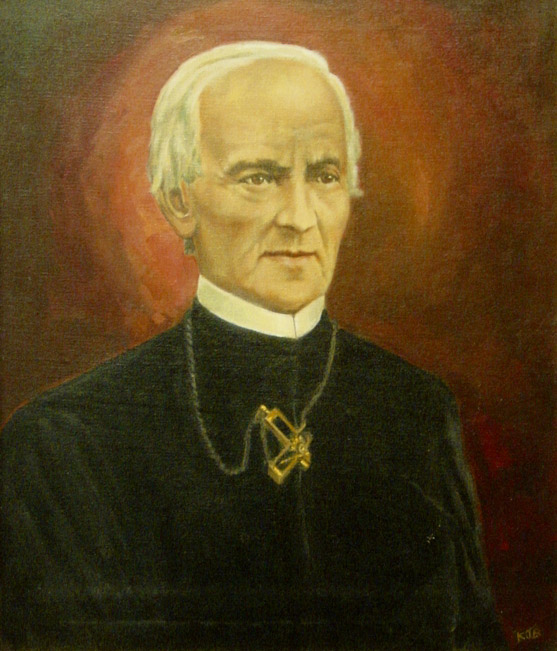
(Painting above of “The Pharisees” by Karl Schmidt Rottluff)

Reflect on page 12 of the Fundamental Principles of the Xaverian Brothers.

Read the obituary of Brother William Drinan, CFX on pages 611-613 of the Xaverian Menology.

  1. Jesus asks his adversaries hard questions about religious traditions and sacred relationships. Have you ever had an experience in which you felt someone prioritized a tradition in a way that got in the way of or hurt an important personal or community relationship? What about if we are the ones who see only the tradition or fear of breaking with it? Who does Jesus ask us to be when we reach these uncomfortable spaces? Not just what do we do, but who shall we be?
  2. Brother William Drinan had numerous accomplishments in his life, and was creative and tenacious in following through with his missions. His bingo strategy to benefit one of the schools is a testament to persistence, optimism, and relationship building. As you read about his remarkable life, consider the paragraph on p. 12 of the Fundamental Principles about how the history of the Congregation is the actual lived expression and development of the Founder’s Charism. Note the reference to cycles of life and death. How do these words give us comfort and inspiration when faced with a problem whose solution is not readily accessible?

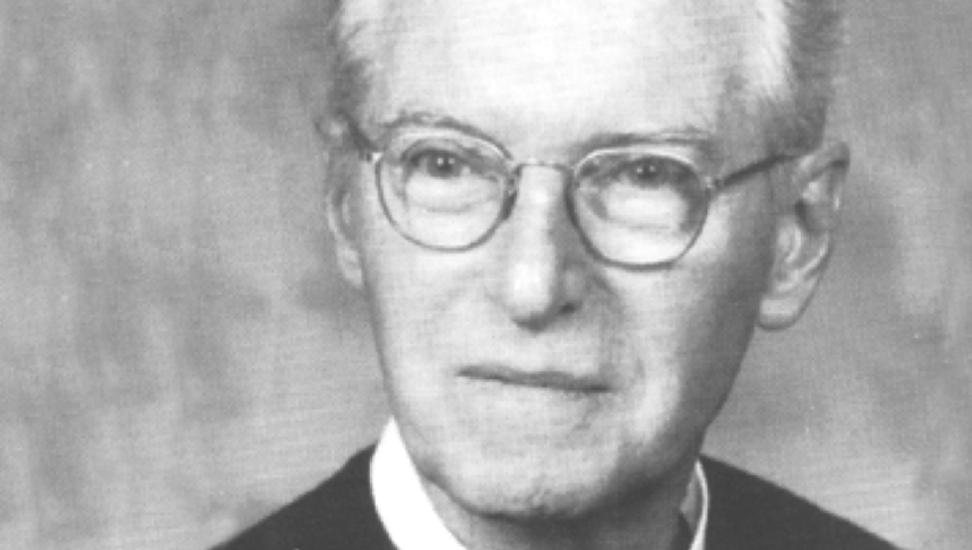
(Above photo of Brother William Drinan, CFX-St. John’s Preparatory School)

Please consider writing your own responses to the readings or reflection questions below, or to reply to other peoples’ contributions. Also, if you know of a person, either religious or lay person, who has modeled the Xaverian way, and wish to share their story, please feel free to add to the comments section. 

Awake From Your Slumber

During the fourth week of Ordinary Time, the readings continue to reflect the themes of encouragement to faith communities and challenges to embrace what is new so that we may maintain what is sacred. Being open to the presence of God in uncertain times figure prominently. Please consider writing your own responses to the readings or reflection questions below, or to reply to other peoples’ contributions. Also, if you know of a person, either religious or lay person, who has modeled the Xaverian way, and wish to share their story, please feel free to add to the comments section. 

Today’s passage from the Letter to the Hebrews contains the memorable “cloud of witnesses” phrase. It is simultaneously mysterious and tangible, reflecting the solidarity of the faithful, living and deceased, walking with us through peril but also through the quiet and mundane parts of our daily journeys. (Painting below “The Cloud of Witnesses” by Eria “Sane” Nsubuga)

Here are the readings for Tuesday, February 4 from the Letter to the Hebrews and the Gospel of Mark.

Reflect on the Description of the Xaverian Charism for Xaverian Brothers Sponsored Schools.

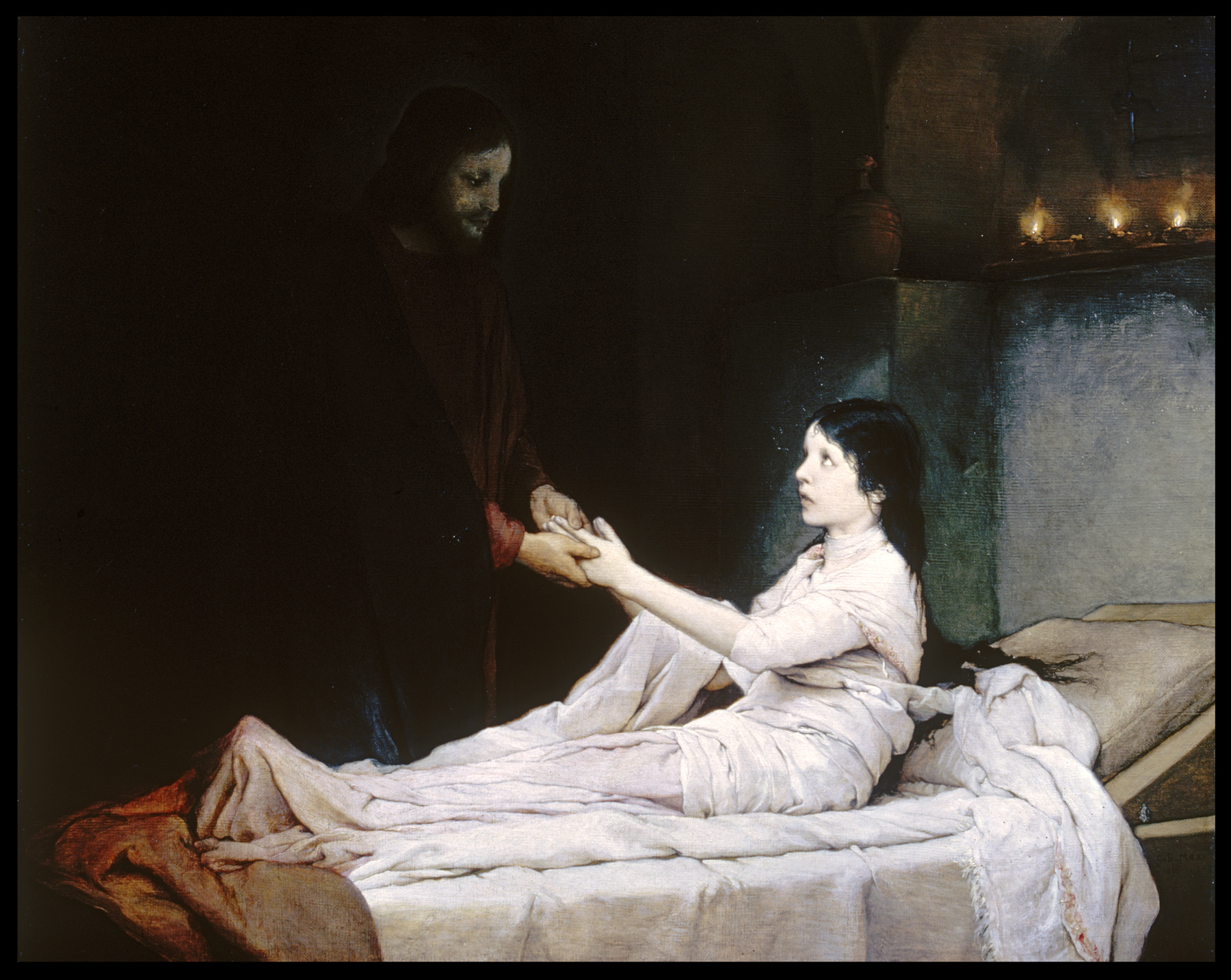
(Above painting of “The Raising of Jairus’ Daughter” by Gabriel Max)

  1. Jesus shocks and even offends people by describing Jairus’ daughter as asleep. What was he trying to say, not necessarily about the girl, but about the adults in the room?
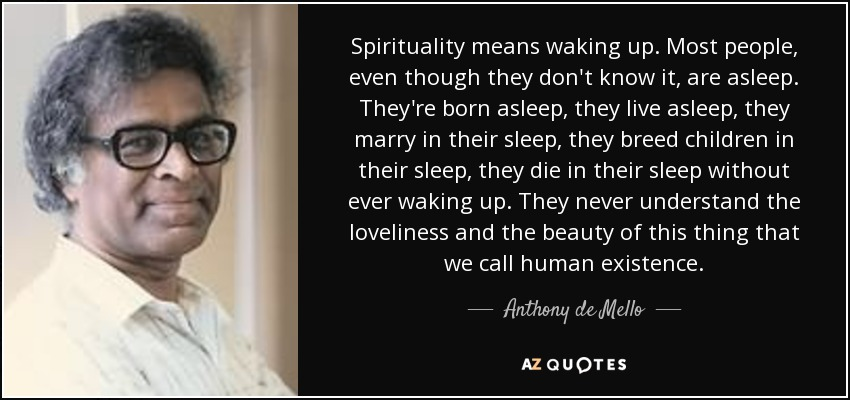
  2. Compare the preamble in the description of the Xaverian charism with the quote below from Anthony de Mello. How does each text reflect the concept of awakening, especially to the daily and unspectacular experiences that are nevertheless grace filled?

Out of Weakness Made Powerful

During the fourth week of Ordinary Time, the readings continue to reflect the themes of encouragement to faith communities and challenges to embrace what is new so that we may maintain what is sacred. Being open to the presence of God in uncertain times figure prominently. Please consider writing your own responses to the readings or reflection questions below, or to reply to other peoples’ contributions. Also, if you know of a person, either religious or lay person, who has modeled the Xaverian way, and wish to share their story, please feel free to add to the comments section. 

(Painting below “Jesus Heals the Gerasene Demoniac”)

Here are the readings for Monday, February 3 from the Letter to the Hebrews and the Gospel of Mark.

Reflect on the prayer, “Prophets of a Future Not Our Own” by Bishop Kenneth Untener.

(Above photo of Brother Plunket Doherty, CFX Teaching at Malden Catholic High School in 1970-Xaverian Brothers)

  1. Are we able to be at peace with the idea that our legacy or life’s work may not be remembered by many, or that we may not see the fruits of our labor? How does this apply to anyone charged with forming or educating a young person?
  2. If you were a follower of Jesus who witnessed him healing the man with the unclean spirit, would you judge the events that unfolded as a success? What was the source of the onlookers’ fears?
  3. A former student once remarked that “Brother Plunket Doherty commanded a roomful of boys with just a look and a whisper.” How can our very dispositions around others be an efficacious way of sharing our faith or understanding of spiritual gifts?

Joy and Storm Clouds

As we begin the fourth week of Ordinary Time, the readings continue to reflect the themes of encouragement to faith communities and challenges to embrace what is new so that we may maintain what is sacred. Please consider writing your own responses to the readings or reflection questions below, or to reply to other peoples’ contributions. Also, if you know of a person, either religious or lay person, who has modeled the Xaverian way, and wish to share their story, please feel free to add to the comments section. 

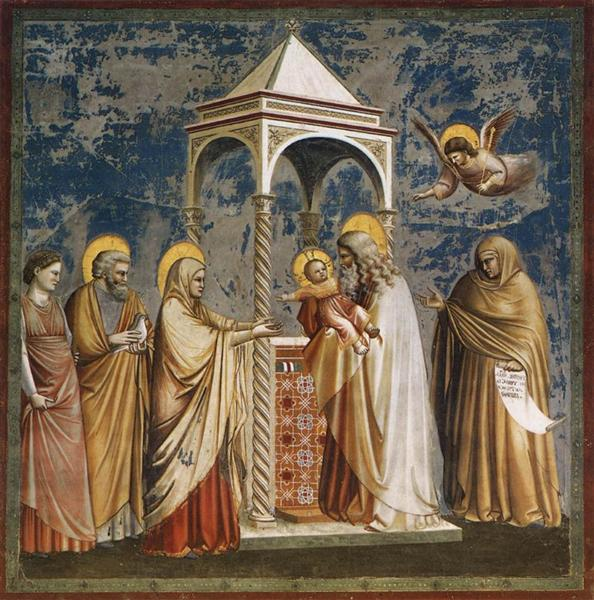
Images of crucibles and foreshadowing of crucifixions permeate today’s readings from the book of Malachi and Gospel of Luke. These are sobering messages but hopefully not foreboding. Christianity, and the spiritual life in general, are not about glorifying suffering or masochism. Rather, just as Mary carried the sorrowful mysteries with her, the more attentive we are to our present realities, including times of dull or acute pain, the easier it is to accept moments of grace and happiness. What can help us in this journey is a commitment to the present tense with contemplative practices, even simple ones, that can put our lived experience into greater focus. Consider the very active life of Br. Philip Neri Crossen (bio below) that was animated by his commitment to stillness in prayer. This week, continue to reflect on the gentle and sometimes urgent prompting and encouragement in the letter to the Hebrews to follow the ways of Jesus, even when the path forward is not clear. Note also the patterns of activity that Jesus establishes for himself and his friends in the Gospel of Mark, and the tensions that his choices cause among even with people who admire him and his ministry. Like Jesus, may we own these uncomfortable moments with others as a part of revealing who we truly are meant to be, rather than to seem in appearance.

(Fresco below “Presentation of Christ in the Temple” by Giotto)

Here are the readings for Saturday, February 1 from the Book of Malachi, the Letter to the Hebrews, and the Gospel of Luke.

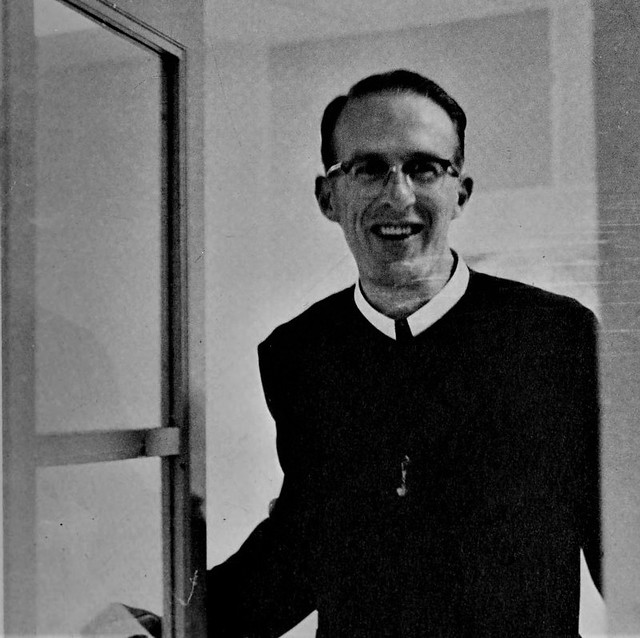
(Above photo of Brother Philip Neri Crossen, CFX-Xaverian Brothers)

  1. Read the appreciation of Br. Philip Neri Crossen by Br. Thomas Ryan. Note the details of Br. Philip’s daily routine and the intentionality of his commitments large and small.
  2. Reflect on the interactions of Mary with Simeon and Anna. How do their omens and warnings fit into a moment that is meant to be both a rite of passage and celebration of life? Remember, the Gospel literally means “Good news!” How can this inform us in our interactions with people we truly love in very active and selfless ways?

Turn Toward Not Away

In this third week of Ordinary Time, the readings continue to reflect the themes of encouragement to faith communities and challenges to embrace what is new so that we may maintain what is sacred. Please consider writing your own responses to the readings or reflection questions below, or to reply to other peoples’ contributions. Also, if you know of a person, either religious or lay person, who has modeled the Xaverian way, and wish to share their story, please feel free to add to the comments section. 

Like yesterday, today’s readings challenge us to embrace what is unknown. We are not to ignore our fears or pretend they do not exist, but instead recognize that these fears-of failure, rejection, mortality, are all real. In doing so, by being honest and vulnerable about what makes us uncomfortable, we can experience a transcendence, a grace that shines bright in the midst of the confusion caused by life’s storms. The author to the Hebrews, ever the cantankerous cheerleader for their community, recounts the difficulties faced by heroes of the Old Testament, and how they connected to the mystery of God even as they knew they would most likely not see the fruits of their labor fulfilled in their lifetimes. Like Jesus in Mark, the author to the Hebrews reminds the audience that faith does not let them avoid the storms, but to engage the storms and emerge stronger, regardless of the immediate outcomes.

(Painting below “Jesus Calms the Storm” by Neil Thorogood)

Here are the readings for Saturday, February 1 from the Letter to the Hebrews and from the Gospel of Mark.

Next, read and reflect upon “A Description of the Xavrerian Charism

(Above portrait of Theodore James Ryken, Xaverian Brothers)

  1. In the Charism statement, we acknowledge that like the Founder, Theodore James Ryken, we are called to be open to being “put in our place.” This implies the need for a disposition of humility but also one of gratitude. How can we experience this gratitude while at the same time navigating the very real and tangible challenges and conflicts that come with trying to live a spiritual life in an environment that may be inhospitable to this life?
  2. It is important to not overlook the humorous detail in the Gospel of Mark that Jesus was fast asleep while out on the boat with the apostles. Ironically, it is the apostles who were actually asleep in this situation. What does this mean and why does Jesus so badly want them and us to wake up? What does Jesus want us to wake up to and recognize, perhaps for the first time?

Trust Me I Am Here

In this third week of Ordinary Time, the readings continue to reflect the themes of encouragement to faith communities and challenges to embrace what is new so that we may maintain what is sacred. Please consider writing your own responses to the readings or reflection questions below, or to reply to other peoples’ contributions. Also, if you know of a person, either religious or lay person, who has modeled the Xaverian way, and wish to share their story, please feel free to add to the comments section. 

The Xaverian Charism calls us to fall in love with God each day. On some days this is quite natural, and extremely difficult on others. I suspect for those of us who pursue a spiritual journey, most days fall somewhat on a continuum between the two extremes. Motivation for stepping into the unknown may be in short supply on any given ordinary day. This is where grace comes in. People who follow the Xaverian way are empowered by five values which help us bear witness to the Charism. The values are: Simplicity, Compassion, Humility, Zeal, and Trust. The values do not exist in isolation and together gives us and our communities a beacon, especially when we are reluctant or fearful. As you read today’s Scriptures and the profile of Brother Raymond Hoyt, CFX, think about the value of Trust and its power to animate us, even on the most ordinary of days. (Painting below “Jesus Lamp Under a Bushel”)

Here are the readings for Thursday, January 30 from the Letter to the Hebrews and from the Gospel of Mark.

Next, read and reflect upon pages 2 and 3 the Fundamental Principles of the Xaverian Brothers.

(Above photo of Brother Raymond Hoyt, CFX)

  1. Read the passage from the Letter to the Hebrews and pages 2 and 3 from the Fundamental Principles together. How do the words and messages in the Fundamental Principles reflect what is revealed in the Scripture, especially about the value of Trust?
  2. Why is Trust so essential to following through on Jesus’ command to not to hide one’s “lamp” or inner light, as well as his admonition about the effects of unconditional giving of self?
  3. Read the text and view the video on the life of Br. Raymond Hoyt, CFX. How did he reflect the Xaverian Charism in daily life, especially witnessing to the value of Trust?

The Rigors of the Spiritual Life

For the second week of the season, the first readings continue to come from an unknown author directed at the somewhat ambiguous audience in early Christianity known as “the Hebrews.” The Gospel readings during Ordinary Time are focused on Jesus and his actions and words, but mostly his actions, in the Gospel of Mark. There is also a reflection question based on documents from the Xaverian Brothers or from accounts of the lives of Xaverian Brothers or lay Partners in Mission. Please consider writing your own responses to the reflection questions below, or to reply to other peoples’ contributions. Also, if you know of a person, either religious or lay person, who has modeled the Xaverian way, and wish to share their story, please feel free to add to the comments section.

Here are the readings for Thursday, January 23 from the Letter to the Hebrews and from the Gospel of Mark. (painting below from wallpapers.com)

Both the letter to the Hebrews and the Gospel of Mark speak to Jesus’ availability, especially to those pushed aside or shunned in their societies. In Mark we also read accounts of “the crowd”, which becomes a character in its own right in this Gospel narrative. The crowd is fascinated with Jesus, but is fickle when it comes to whom and when it chooses to venerate, ignore, or condemn. People in the crowd are reactive and not reflective. Jesus, on the other hand, possesses the spiritual discipline to be faithful to his mission and not be distracted by the temptations of celebrity, or to become someone that he is not to fit the desires of the crowd. Consider when you are having a moment in which you are tempted to speak or act out of expediency and not out of authenticity? When are those weak moments most likely to occur, and when can you reflect on these and other events in your day-in the morning, on a commute, or before you retire for the evening? Think about reflection to prevent reaction.

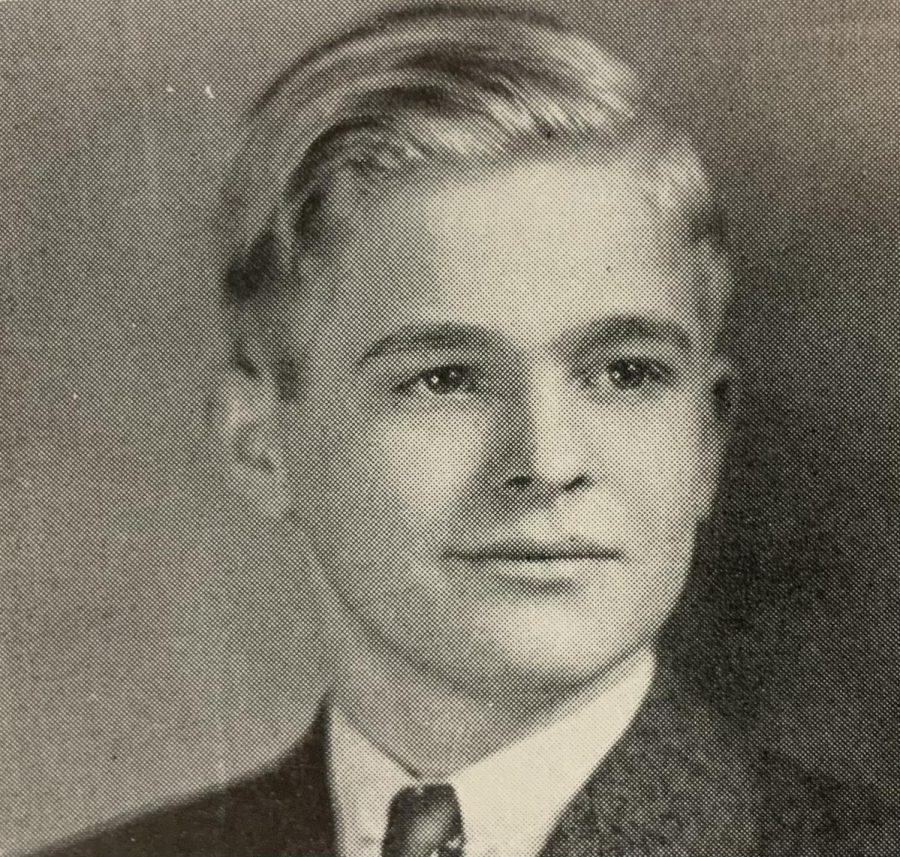
Read page 12 of the Fundamental Principles of the Xaverian Brothers and then read the biography of Br. Hugo Hammer, CFX (p. 125 and 126 in the Xaverian Menology)

(Above Hugo Hammer, CFX as a Senior at St. Xavier High School in Louisville, KY 1940)

By all accounts, Br. Hugo led a vigorous and active life! How do the spiritual recommendations on p. 12 of the Fundamental Principles direct us to intentionally reflective practices to sustain our energy in our lives that in their own way are just as busy as Br. Hugo was?

The Quickening

As we begin the liturgical season of Ordinary Time in the Christian tradition, we are invited to reflect on the daily readings. For this first week of the season, the first readings come from an unknown author directed at the somewhat ambiguous audience in early Christianity known as “the Hebrews.” The Gospel readings during Ordinary Time are focused on Jesus and his actions and words, but mostly his actions, in the Gospel of Mark. Please consider writing your own responses to the reflection questions below, or to reply to other peoples’ contributions. (painting of Christ Healing a Leper by Vrindaji Bowman)

Here are the readings for January 16, 2025 from the Letter to the Hebrews and from the Gospel of Mark.

  1. The author to the Hebrews is concerned about “hardening of peoples’ hearts.” Why is the author so concerned about attitude, and for people not to be grim do-gooders?
  2. Besides not being mobbed by crowds, what might another reason have been for Jesus telling the leper not to say anything about being healed?

Read pages 5 and 6 of the Fundamental Principles of the Xaverian Brothers.

  1. How does the author of the Fundamental Principles sound similar to the author of the Hebrews about choosing a way of life and about one’s attitude towards this life?
  2. “Quickening” is often used to refer to the first signs of life or a sudden stimulation or revelation. How does the author of the Fundamental Principles reflect on a person’s conversion or revelation of God?

(Photo above of Mr. Joseph Cegelski, math teacher at Mount Saint Joseph High School in Baltimore, MD from 1965-2015)

Empathy is hard to teach

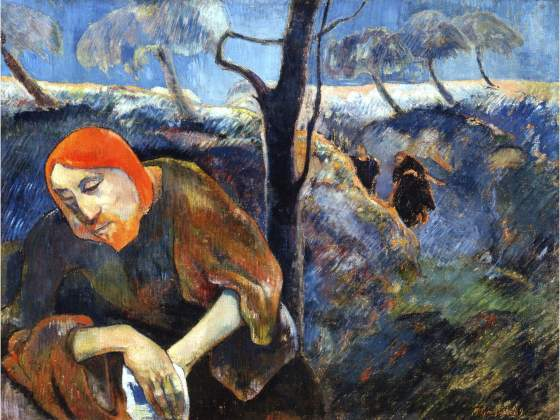
As we begin the liturgical season of Ordinary Time in the Christian tradition, we are invited to reflect on the daily readings. For this first week of the season, the first readings come from an unknown author directed at the somewhat ambiguous audience in early Christianity known as “the Hebrews.” The Gospel readings during Ordinary Time are focused on Jesus and his actions and words, but mostly his actions, in the Gospel of Mark. Please consider writing your own responses to the reflection questions below, or to reply to other peoples’ contributions. (painting below by Paul Gauguin)

Here are the readings for January 15, 2025 from the Letter to the Hebrews and from the Gospel of Mark.

  1. What do you believe that the author of the book of Hebrews is saying to the audience about the simple but difficult dispositions Christians should have in their interactions with other people and with the world?
  2. In Mark, Jesus’ disciples do not understand why he left the crowd to be alone and pray. Consider when you have the opportunity to do as Jesus did, for however short a time, but choose not to and revert to a familiar pattern or behavior. How can you break this cycle of inertia?

Read page 5 of the Fundamental Principles of the Xaverian Brothers.

How does the author of the Fundamental Principles emphasize the dispositions and practices of Jesus from the previous readings, and how does the author encourage us to persevere in being countercultural?

Above photo of Br. Harry Eccles, CFX and Br. Richard Mazza, CFX at the Sant in Haiti.

A Healing Sabbath

As we begin the liturgical season of Ordinary Time in the Christian tradition, we are invited to reflect on the daily readings. For this first week of the season, the first readings come from an unknown author directed at the somewhat ambiguous audience in early Christianity known as “the Hebrews.” The Gospel readings during Ordinary Time are focused on Jesus and his actions and words, but mostly his actions, in the Gospel of Mark. Please consider writing your own responses to the reflection questions below, or to reply to other peoples’ contributions. (Below: Eleventh century fresco of the Exorcism at the Synagogue in Capernaum)

Here are the readings for January 14, 2025 from the Letter to the Hebrews and from the Gospel of Mark.

  1. When Jesus drives out the unclean spirit, why does he command the spirit to be quiet, rather than seizing the opportunity for the people to learn more about his identity?
  2. Jesus taught and healed on the sabbath, the day of rest. The purpose of the sabbath is not just about disconnecting, but about reconnecting. Reconnecting can take energy on a day of rest. How can you be mindful of the balance between disconnection and reconnection and put it into practice on a day-long or hour-long sabbath?

Read pages 3 and 4 of the Fundamental Principles of the Xaverian Brothers.

On page 3 of the Fundamental Principles, the author states that “at times you will discover that God’s ways are not your ways, and God’s thoughts are not your thoughts. When this happens, try to surrender yourself trustingly into the arms of your Parent God.” At what times in your life have you made this discovery (good, peaceful, stressful, grief-stricken, angry, relaxed) and how have you responded as a kind of “surrender?”

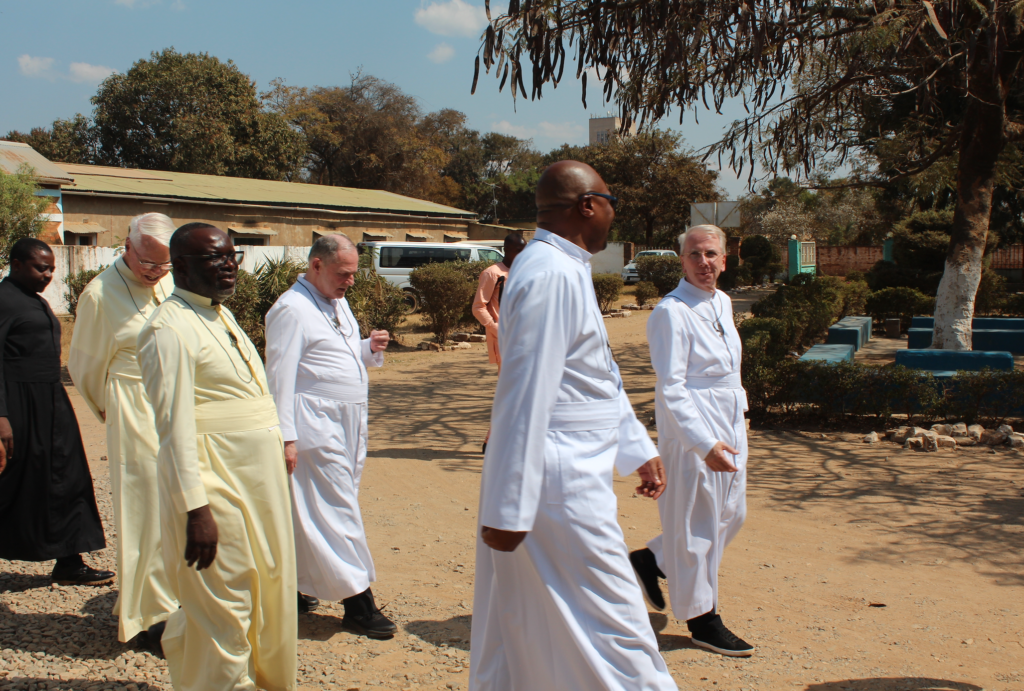
(Photo of Xaverian Brothers gathering in Congo https://xaverianbrothers.org/2022/09/12/a-visit-to-congo/)