As we begin the liturgical season of Ordinary Time in the Christian tradition, we are invited to reflect on the daily readings. For this first week of the season, the first readings come from an unknown author directed at the somewhat ambiguous audience in early Christianity known as “the Hebrews.” The Gospel readings during Ordinary Time are focused on Jesus and his actions and words, but mostly his actions, in the Gospel of Mark. Please consider writing your own responses to the reflection questions below, or to reply to other peoples’ contributions. (Below: Eleventh century fresco of the Exorcism at the Synagogue in Capernaum)
When Jesus drives out the unclean spirit, why does he command the spirit to be quiet, rather than seizing the opportunity for the people to learn more about his identity?
Jesus taught and healed on the sabbath, the day of rest. The purpose of the sabbath is not just about disconnecting, but about reconnecting. Reconnecting can take energy on a day of rest. How can you be mindful of the balance between disconnection and reconnection and put it into practice on a day-long or hour-long sabbath?
On page 3 of the Fundamental Principles, the author states that “at times you will discover that God’s ways are not your ways, and God’s thoughts are not your thoughts. When this happens, try to surrender yourself trustingly into the arms of your Parent God.” At what times in your life have you made this discovery (good, peaceful, stressful, grief-stricken, angry, relaxed) and how have you responded as a kind of “surrender?”
As we begin the liturgical season of Ordinary Time in the Christian tradition, we are invited to reflect on the daily readings. For this first week of the season, the first readings come from an unknown author directed at the somewhat ambiguous audience in early Christianity known as “the Hebrews.” The Gospel readings during Ordinary Time are focused on Jesus and his actions and words, but mostly his actions, in the Gospel of Mark. Please consider writing your own responses to the reflection questions below, or to reply to other peoples’ contributions.
In the letter to the Hebrews, why is the author comparing Jesus to angels? What is the author trying to say not only about Jesus but about human beings and our own worth?
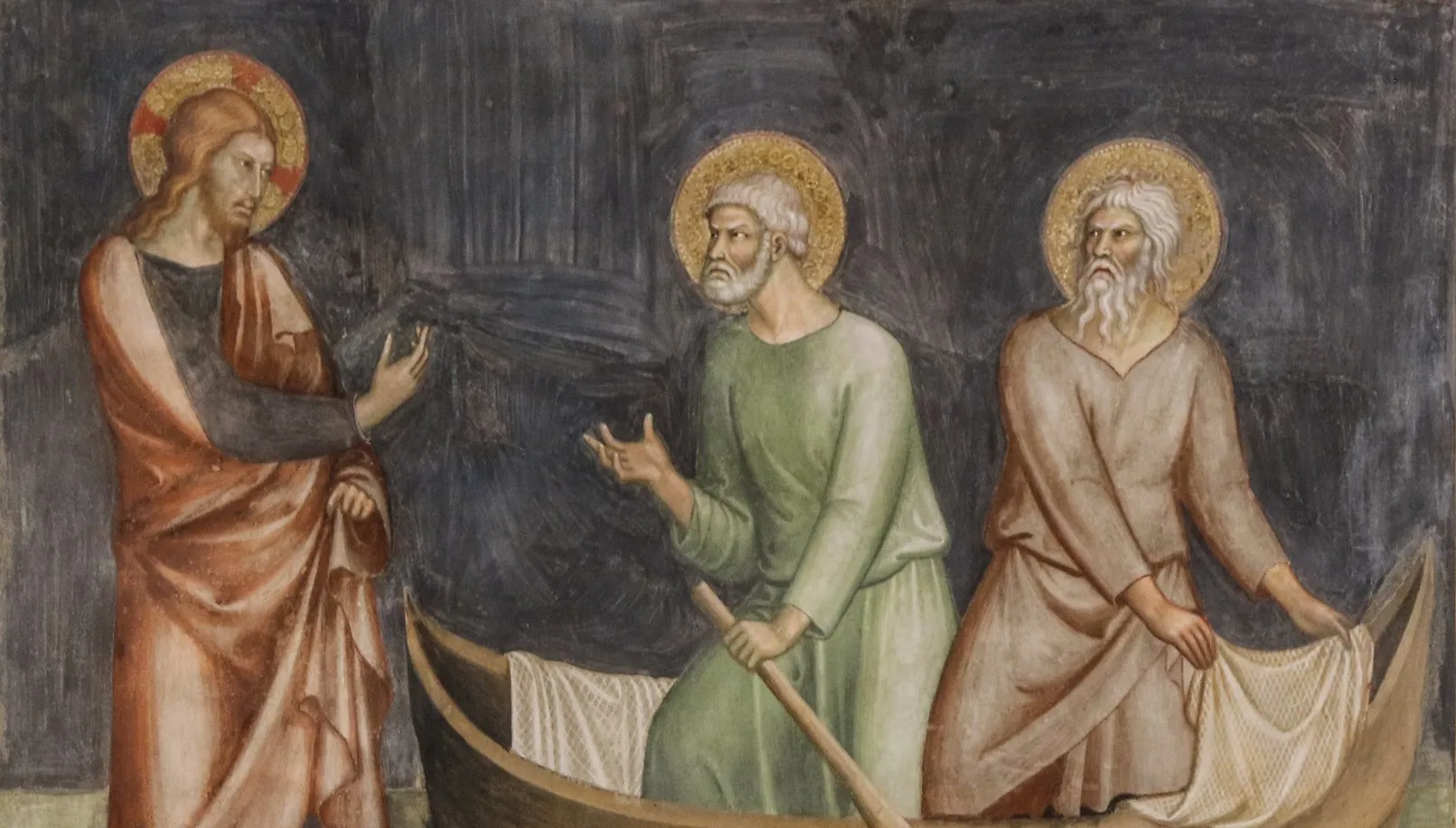
From the Gospel of Mark, a potential hot take-did Peter, Andrew, James and John follow Jesus in part because they were bored and were sick and tired of smelling like old fish and brine? Is there anything wrong with that, or with making positive choices that begin from less than selfless motives?
Being present to the unspectacular but graced moments in Our Journey of life-January 12-18, 2025
“One who knows oneself, knows God: and one who knows God is worthy to worship Him as is right. Therefore, my beloveds in the Lord, know yourselves.” – St. Anthony of Egpyt
As we begin the liturgical season of Ordinary Time in the Christian tradition, we are invited to reflect on the daily readings from the Bible. This week, the first readings come from an unknown author directed at the somewhat ambiguous audience in early Christianity known as “the Hebrews.” The Gospel readings during Ordinary Time are focused on Jesus and his actions and words, but mostly his actions, in the Gospel of Mark. In the letter to the Hebrews, the author highlights the weakness of the human condition but reminds us that we are still loved and capable of loving. We are worth redeeming. That is the nature of God which is a part of us humans. Belief comes from wanting to be transformed and be more like Christ, being present, humble, and willing to sacrifice out of love. This is a reminder about humility and persistence and how they are linked.
In the Gospel of Mark, Jesus is on the move and inviting anyone on the ride with him. We begin to see a conflict between Jesus and those who cannot get out of their own way, or who are so attached to institutional norms that they cannot pursue the path of holiness that they claim to represent. At the same time, Jesus models holiness through the balance he strikes in his daily decisions. He speaks of the Kingdom of God and then acts of of compassion to heal the body, mind, and spirit. Yet rather than revel in his newfound celebrity, after each extraordinary sign Jesus withdraws to quiet spaces for contemplation and reflection on his relationship with God and his neighbors.
Beginning tomorrow and each day this week, we will publish short reflections and questions on the daily readings and invite you to respond in the comments section. We will also consider how the revelation in the Scripture is present in the Xaverian Charism, and how we may respond in our actions and contemplative moments.
Each week, we also reflect on the life of a person who embodied or embodies the Xaverian Charism, one who “falls in love with God, and in God’s service.” This week, consider the life of Br. Nilus Cullen, CFX. The biography is from the Xaverian Brothers Menology.
BROTHER NILUS CULLEN (Cornelius Francis Cullen) Born: Baltimore, Maryland, December 7, 1912 Died: La Paz, Bolivia, November 15, 1995 Cornelius Cullen came to know the Xaverian Brothers as a student at Mount St. Joseph’s. He graduated in 1931, and for a while continued his studies at Loyola College, Baltimore. He entered the congregation on September 17, 1933 and on March 19 of the following year he was admitted to the novitiate and was thereafter known as Brother Nilus. In June, 1938, after professing final vows on March 19, he completed his studies at Catholic University and the following September began his teaching career at the Mount. His qualities as a leader were recognized early, and in 1946, after eight years at his first mission, at the age of 34, he was appointed superior and headmaster of Leonard Hall, Leonardtown, Maryland. For the next thirty-six years, Nilus filled positions of leadership including superior at St. Joseph’s Preparatory School, Bardstown, Kentucky, (1953-1956), provincial of the American Province (1956-1962) provincial delegate for Bolivia (1962-1968), and director of the Educational Center in Carmen Pampa, Bolivia (1962-1982). In 1962, at age fifty, Brother Nilus began the second phase of his mission as a Xaverian Brother. Having served on the U.S. Bishops’ special committee on Latin America when provincial, he responded to the request of Bishop Thomas Manning, a former student of his at the Mount, to begin a Xaverian mission in the Prelacy of Coroico with the education of very poor Indian children. The situation in Bolivia at this time called for his assets as a leader. Nilus built buildings, bulldozed roads, dug trenches to channel water to the school. He fell in love with the campesinos, while helping to organize a coffee cooperative, develop a teacher training program, an elementary school and an education program for adult campesinos who never went to school. He even designed a street plan for the local community of Carmen Pampa which today bears his name, Villa Nilo. In 1982, Nilus left Carmen Pampa and went to the Seminario del Espiritu Santo in Espada to help Bishop Manning build the seminary. Nilus’ contribution to the physical plant is evident everywhere at Espada. But Nilus also taught at the seminary—lessons beyond English and accounting—lessons that would last: on any given night, one would find his room filled with the young seminarians. For them Nilus was the father many never had, a friend, and a trusted counselor. He had made room in his heart so that the campesinos would feel at home in his presence and in doing so he made Bolivia his home. It was his wish to finish his life and mission as a Xaverian with the people he had come to love. Brother Nilus died at the Hospital of the Assumption in La Paz in the arms of one of the seminarians, now Father Freddy Del Vilar, who serves as a curate in Sorata near Espada. The funeral Mass was celebrated by his former student, Bishop Thomas Manning, at the Seminario del Espiritu Santo in Espada where he was laid to rest.
Questions to Contemplate This Week
Note the authentic connections that you give and those that you receive each day. Is it balanced?
Whom have you encouraged each day while it is still today?
Why is sin deceitful? Where or when do you find yourself aware of this deceit in your own thoughts and choices?
Jesus is constantly in the presence of unclean or dirty people-fishermen, lepers, people with troubled spirits, corrupt officials, and prostitutes. What daily interactions make us uncomfortable but are valuable for us and the ones we should interact with?


 Ordinary and Unspectacular in the Liturgical Year